The Best Lesson Warm Up!
Warm ups are not only beneficial for your rider but also for your horse! In designing the ultimate warm up for your lesson you will want to include a balance of warming up that benefits both the horse and rider. For the purpose of this article we will focus on instructional design of the warm up with a heavy rider focus as plenty of programs have designated horse warm up established based on the horse’s needs.
Why are warm-ups so important?
- A warm-up physically helps prevent injuries, enhances range of motion, and prepares aerobic and anaerobic pathways for the demands of exercise.
- Mentally, it aids engagement with the rider, improves focus and concentration, and helps them become aware and present.
- Additionally, it acts as a preview for you as an instructor, giving you a chance to notice areas of challenge that might become present in your lesson.
So, what is the best warm-up?
The best warm-up is specifically designed based on your lesson topic and rider.
…and here’s how you do it!
First, you will start by having a clear objective for your lesson.
Now, think of these three things that your rider will need to achieve the goal.
- What muscles will be engaged and how?
- What joint will need to move and how?
- What can help your rider achieve better postural alignment?
With those three questions in mind, brainstorm movements that you feel would help towards your objective. Ideally, you are incorporating upper and lower body engagement in the stretches.
So, you could stop there, but I encourage you to add a few more thoughts.
- What verbs will you be using to describe movements in your lesson?
- Can you use your warm-up to draw attention to your ring setup or volunteers?
Those last two questions take a good warm-up to a GREAT warm-up!
So, let’s come up with examples!
Let’s say your objective was “variations within the gait using seat aids,” and our ring setup is four cones marking the start and finish on each long side of the arena. Let’s combine everything into one warm-up since that would be harder than breaking it into multiple warm-ups.
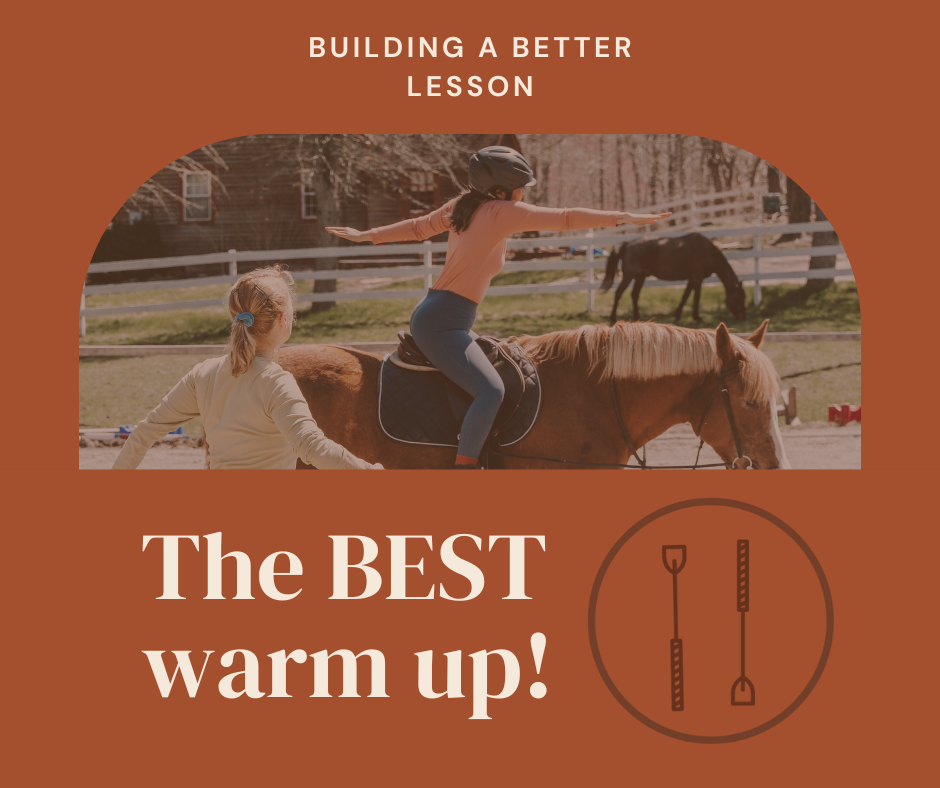
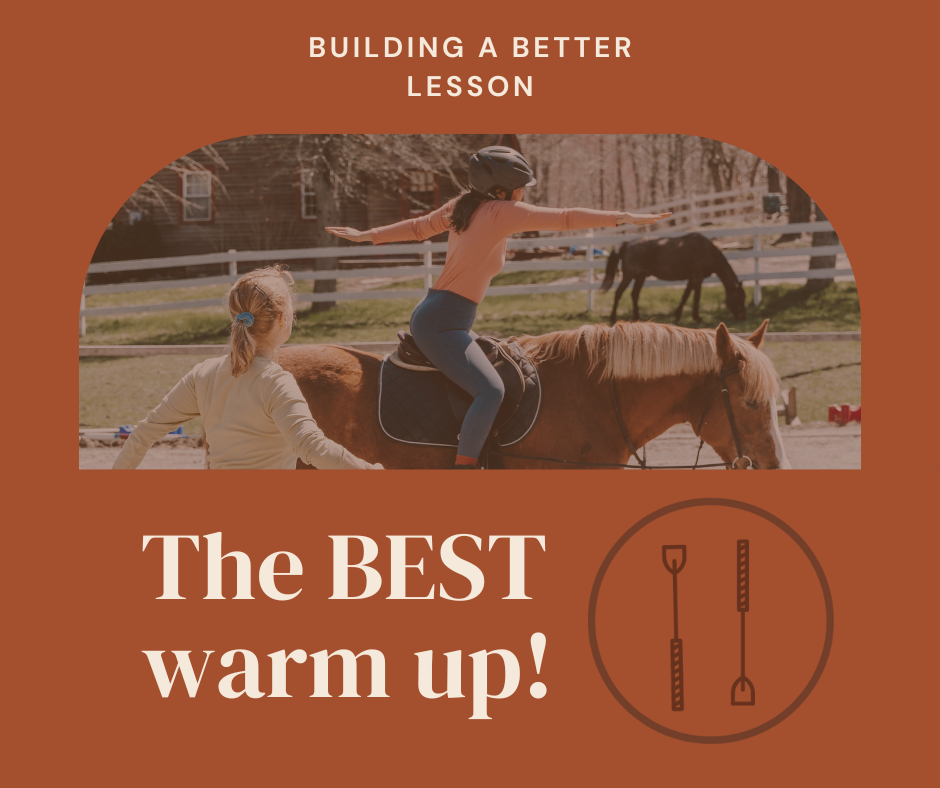
I could ask my riders to do leg swings or bicycle legs to engage their core and glutes while creating mobility in the hip joint. Maybe I am also hoping to improve a slight chair seat with a rounded lower back. I could include outstretched airplane arms if the rider could accommodate both.
Now is where your warm-up can really start to tie everything together. This is the part that takes your warm-up to the next level.
For our example objective of “variations within the gait using seat aids,” we will have a following seat or a slowing/resisting seat. So, maybe we incorporate finding and following the horse’s movement, or I can ask them if they feel their seat bones, or we could try an exercise faster or slower.
See, isn’t this getting fun?
Now, once you get your riders mounted and before you get going with your directed warm-up, you can ask your riders what is in the ring. Four cones in the ring could mean four reps in each set, or you could start your reps at one cone and stop at the next.
If the rider has volunteers, incorporating volunteers in warm-ups is a great way to build rapport and connection for the student. In this example, you can have them be the targets for the knee up or leg swings and/or ask them to count with the rider. Overall, I find volunteers more engaged and attentive when they have specific tasks to support the rider.
The last thing I will add is that toys and props or children’s movement songs can be the golden ticket for those riders who are not necessarily engaged in direct verbal directions. If you cleaver, you can create your own from a nursery rhyme! Like in this example you could take the tune from “Wheels on the Bus” and create movements that way! Or pull up a children’s faster/slower song. Or use the skeleton song to identify parts of the body then highlight the “hip bone” and that it connects to the leg bone and back bone.
A well-designed warm-up serves as a vital preparation tool, both physically and mentally, for riders. By tailoring your warm-up to the specific lesson topic and individual riders’ needs, instructors can enhance engagement, focus, and overall readiness while spotting potential challenges early on. Incorporating targeted movements, verbal cues, and environmental elements elevates the warm-up from adequate to exceptional, setting the stage for a productive and successful lesson experience.