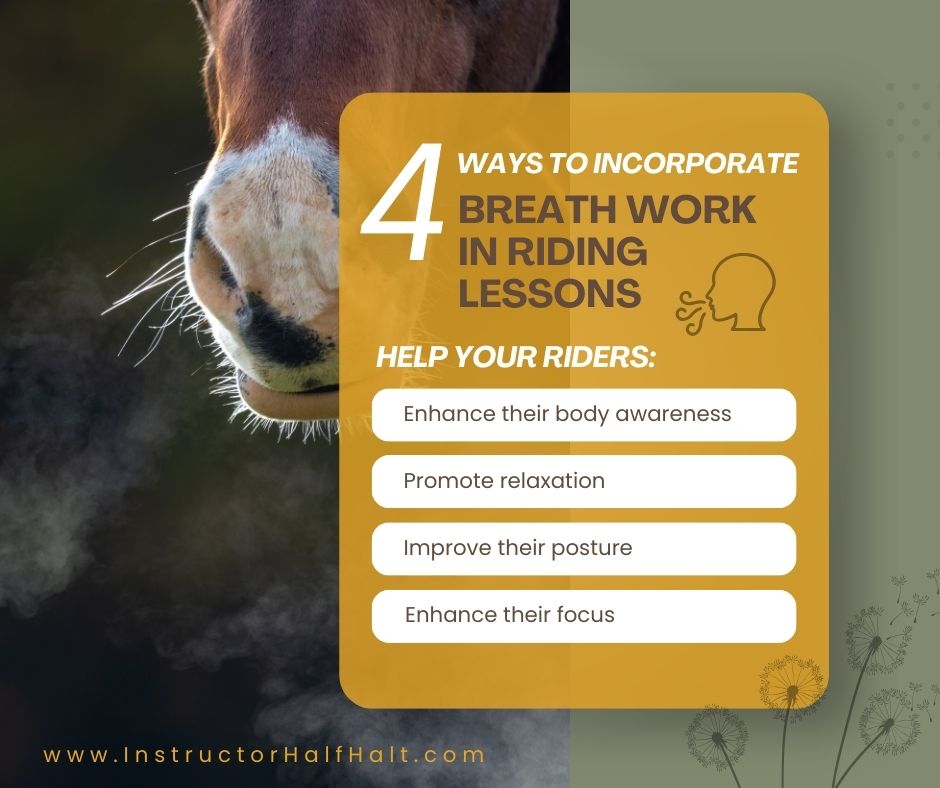
4 Ways to Incorporate Breath Work In Riding Lessons
Breathing is a powerful tool that can profoundly influence physical, emotional, and mental well-being when harnessed effectively. Have you ever noticed how something as simple as focusing on breath can transform both your rider’s and horse’s experience during a lesson?
Breath can….
- Enhances Body Awareness: Focusing on your breath helps you become more aware of your body’s sensations and movements. This heightened awareness enhances control and precision, allowing for more accurate postural adjustments and aids. A rider with body awareness is going to be able to better feel changes in their horse, plus notice when they are off balance ultimately helping them become a better rider.
- Promotes Relaxation: Deep, controlled breathing activates the parasympathetic nervous system, which helps reduce stress and promotes a state of calm. As the rider relaxes through deep breathing, this calmness extends to the horse, enhancing their connection and reducing tension in both. The relaxation is also noted to help improve balance and stability and helps prevent injury.
- Improves Posture: Proper breathing supports better posture by engaging the core muscles and encouraging a natural alignment of the spine. Posture, core, and engagement—need I say more? These are critical for safe and effective riding.
Got a rider that is lacking energy? Efficient breathing delivers more oxygen to your cells, which can help boost your overall energy and vitality.
Got a rider that needs help with emotional regulation or mental focus? A little breathwork helps calm the mind and reduce the distractions to support mental clarity.
Got a rider that doesn’t notice what their horse is doing? Breath awareness is a cornerstone of mindfulness practices, helping you stay present and engaged in the moment.
If your goal is to address some of the things above to improve your student’s riding, then I feel as a riding instructor, we can encourage better breathing to support both our riders and our horses.
Have you wondered how you can encourage great breathing in your lesson when the standard “ok, take a deep breath” doesn’t fit the bill?
Here are some ideas to consider:
Sing and Hum
My favorite way to help with breath is singing! Something as simple as asking your little rider to help their horse learn the alphabet and ask them to sing the ABC’s with you. If your rider is shy about singing, have them hum along (which if you didn’t know, provides more stimulation to the vagas nerve as an added bonus). Say your rider is a little older and nursery rhymes are not appropriate, play their favorite song on a speaker and ask them to sing or hum along.
Now if singing and humming is not your style, there are 3 more “traditional” techniques for breath work that you can incorporate in your lesson to benefit your riders and horses. For some students it might be as simple as asking them to take a few deep breaths but others might need a little more direction.
One thing I want to caution you of is you need to be aware that repetitive forced exhalation can lead to lightheadedness or hyperventilation. Communicate with your rider.
Belly Breathing
Belly breathing or diaphragmatic breathing is focused on breathing in through the nose to expand their belly. For this I like to have riders notice their horse’s breath before work is underway. Have them notice their horse’s nostrils changing, ask them to feel the horses barrel expand and contract. From there I will ask my riders to expand their belly to match their horse’s breath. Matching the horse’s breath for a few moments helps riders slow down their own breathing and become more mindful.
Box Breathing
Box breathing is another popular approach. This is when you inhale for a count of four, hold the breath for four counts, exhale for four counts, and hold again for four counts. One easy way to incorporate this in your lessons is to pair it with the horse’s movement or foot falls. The count can vary based on your horse and rider, but the horse’s natural rhythm supports this technique. In the beginning, I help my riders learn this technique by counting out loud for them and gestures the inhale, hold, exhale, pause.
The Relaxing Breath
The 4-7-8 Method or the relaxing breath involves inhaling through the nose for a count of 4, hold the breath for a count of 7, and exhaling through the mouth for a count of 8. The emphasis being the longer exhale that helps promote relaxation. For this technique I find props helpful if my horse is ok with them. A spur of the moment prop could be as simple as picking dandelions from the grass and blowing away the seeds. One of my favorites is having my rider blow through a straw to make the horse’s mane move. This simple activity encourages riders to control their exhale gradually and deliberately. Another prop I use that is popular with the kids are bubbles or little party horns. I find the party horns without sound that roll out and back like a frog tongue. For this they have to hold a slow blow in order to keep the horn extended so we make a fun game of it.
I think the most fun thing to do in all of these exercises is to watch how the horse changes through the process of the rider experimenting with their breath. You can even use the horse’s current demeanor as an excuse to encourage your rider to do some breathing exercises if that would be motivating for them. “I notice (insert horse’s name) could use a little help with relaxation, let’s see if we can use our breath to help (horse’s name) to relax and flow evenly through their body.
The thing that I appreciate the most, every single time I do breathing exercises with a rider, the horses all start to show signs of relaxation in the process. I love sharing those signals I notice with the rider to highlight the benefit of their horse getting to a more relaxed state. Plus it’s an amazing opportunity to demonstrate how amazing horses connect with us.
Attention to breath can be extremely beneficial to help regulate whether it’s at the start of the lesson, with a transition, or if things are simply not going as planned. Take a moment, let the rider find something from within to better their connection and riding with these amazing creatures! Incorporating these breathing exercises into your lessons can transform the way your riders connect with their horses, bringing more mindfulness and harmony to every ride.
Want more tips, tricks and ideas? Click here to Join our E-mail list so you don’t miss out!